Free Ochem tutoring every Thursday. How to join ›

Ph.D. in Chemistry · UC Irvine

Partho K. Paul

Synthetic & Electrochemist

Advancing scalable CO₂ capture technologies by understanding the fundamental mechanisms at play on the molecular level for both aqueous and organic systems.

  • Ph.D. in Chemistry, UC Irvine (2026)
  • DOE SCGSR Fellow at Brookhaven National Lab
  • Open to teaching, postdoctoral, and industry R&D roles
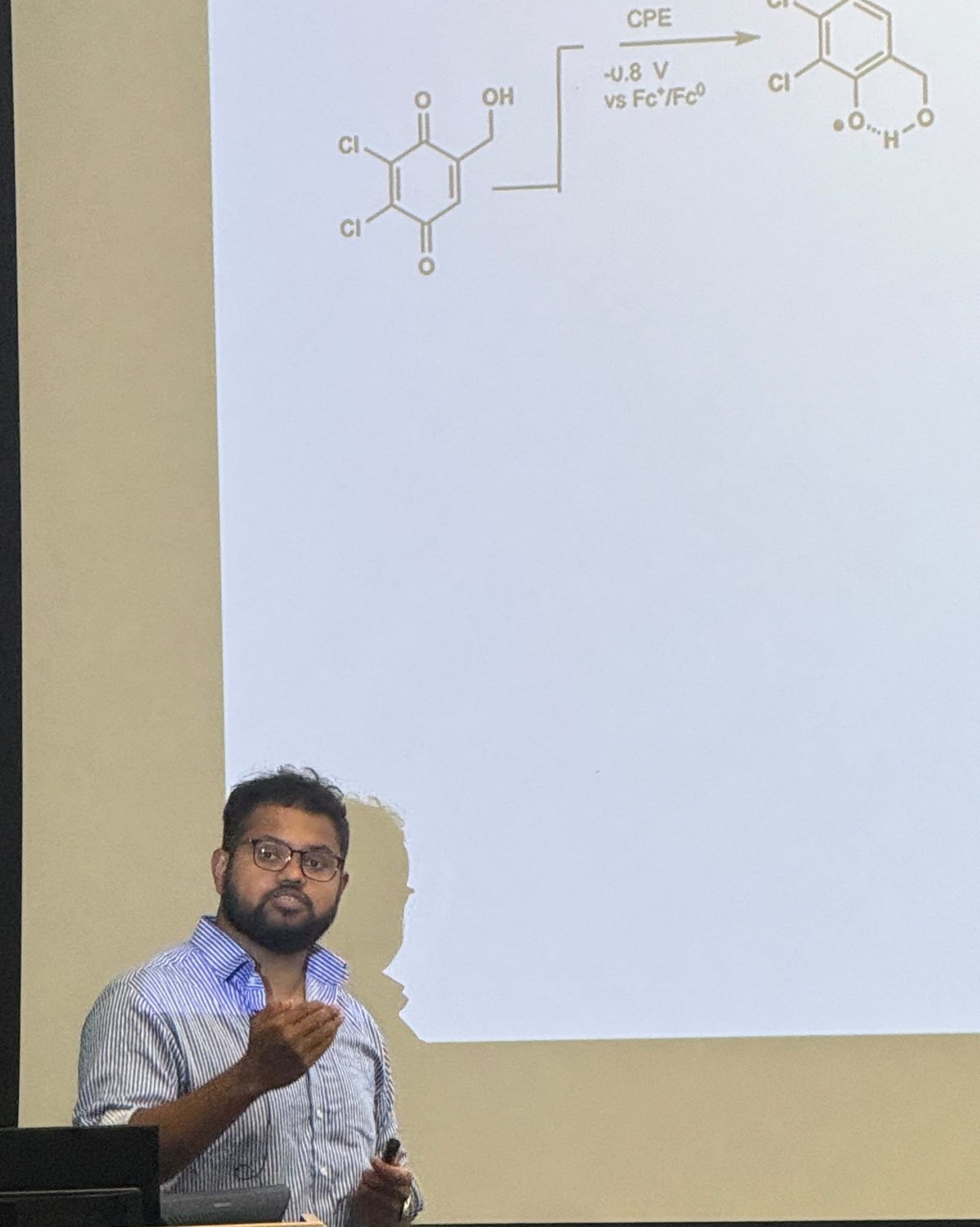
Partho K. Paul presenting his research, with a quinone reduction scheme on the screen behind him

Research

Research focus.

I make molecules for CO₂ capture and catalysis, then measure how they behave at electrodes and in solution.

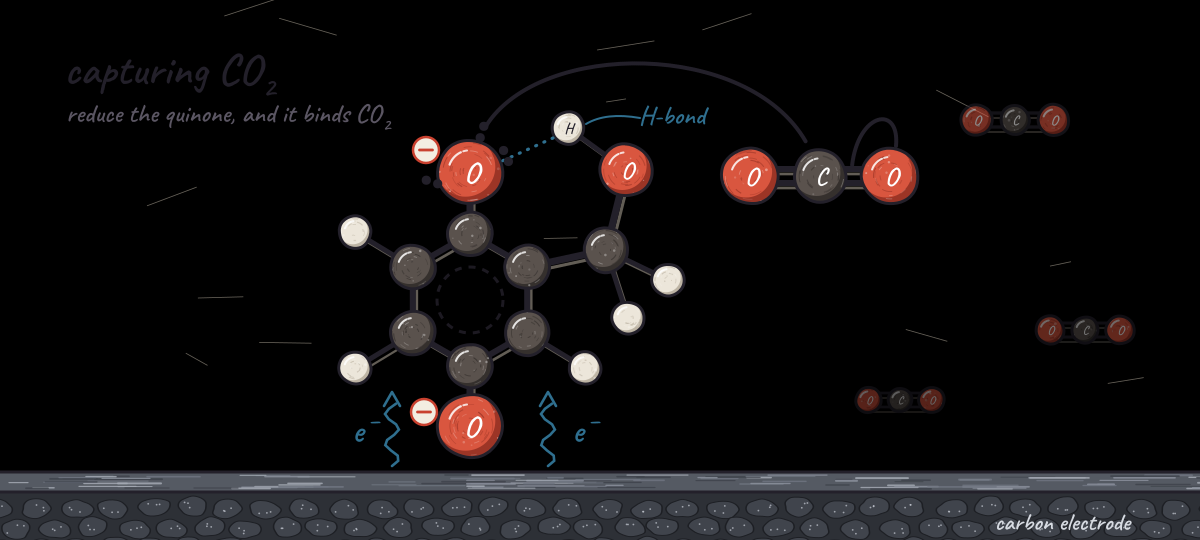
Illustration: a hydroxymethylated quinone dianion, formed by two electrons from a carbon electrode, binds CO₂ while its hydroxymethyl arm hydrogen-bonds to the phenoxide oxygen.

Hydroxymethylated Quinones for CO₂ Capture

Electrochemical CO₂ capture using quinones is a promising alternative to energy-intensive amine scrubbing. However, the negative redox potentials needed to generate strongly nucleophilic dianions also increase oxygen sensitivity. My research tries to solve this problem by introducing a covalently linked H-bonding arm connected through a flexible benzylic C–C bond to the quinone scaffold. Upon two-electron reduction, this arm rotates to position the hydroxymethyl group to stabilize the dianion via H-bonding, circumventing the fundamental linear trade-off that has constrained quinone-based capture systems.
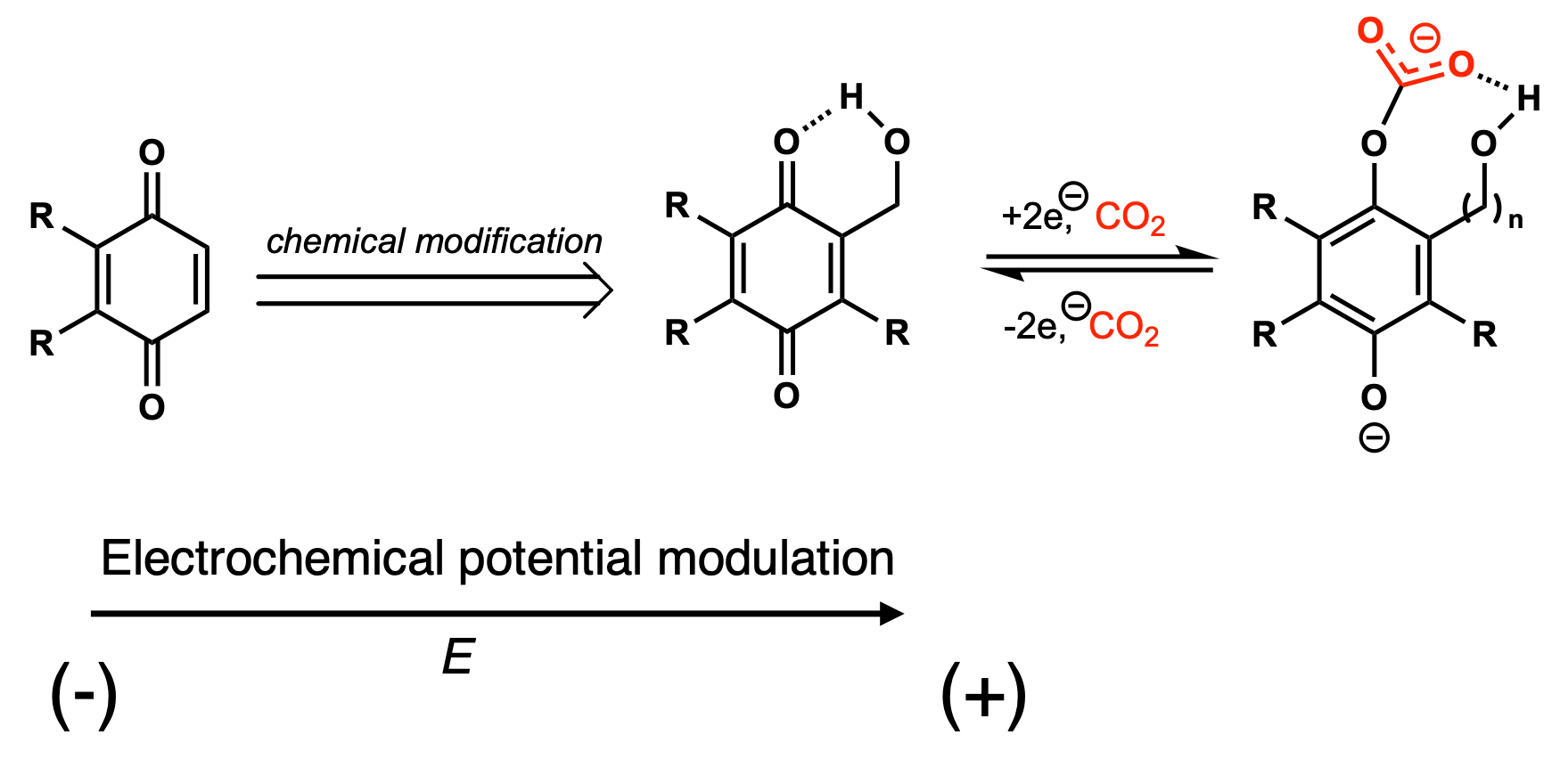
Hydroxymethylated quinone CO₂ capture scheme
  • Synthesized and characterized 6+ hydroxymethylated quinone (HMQ) derivatives.
  • Spectroscopic/electrochemical confirmation of aryl-carbonate adducts.
  • Independent control over reduction potential and binding affinity.
Alloxazine Derivatives as Tunable PCET Mediators

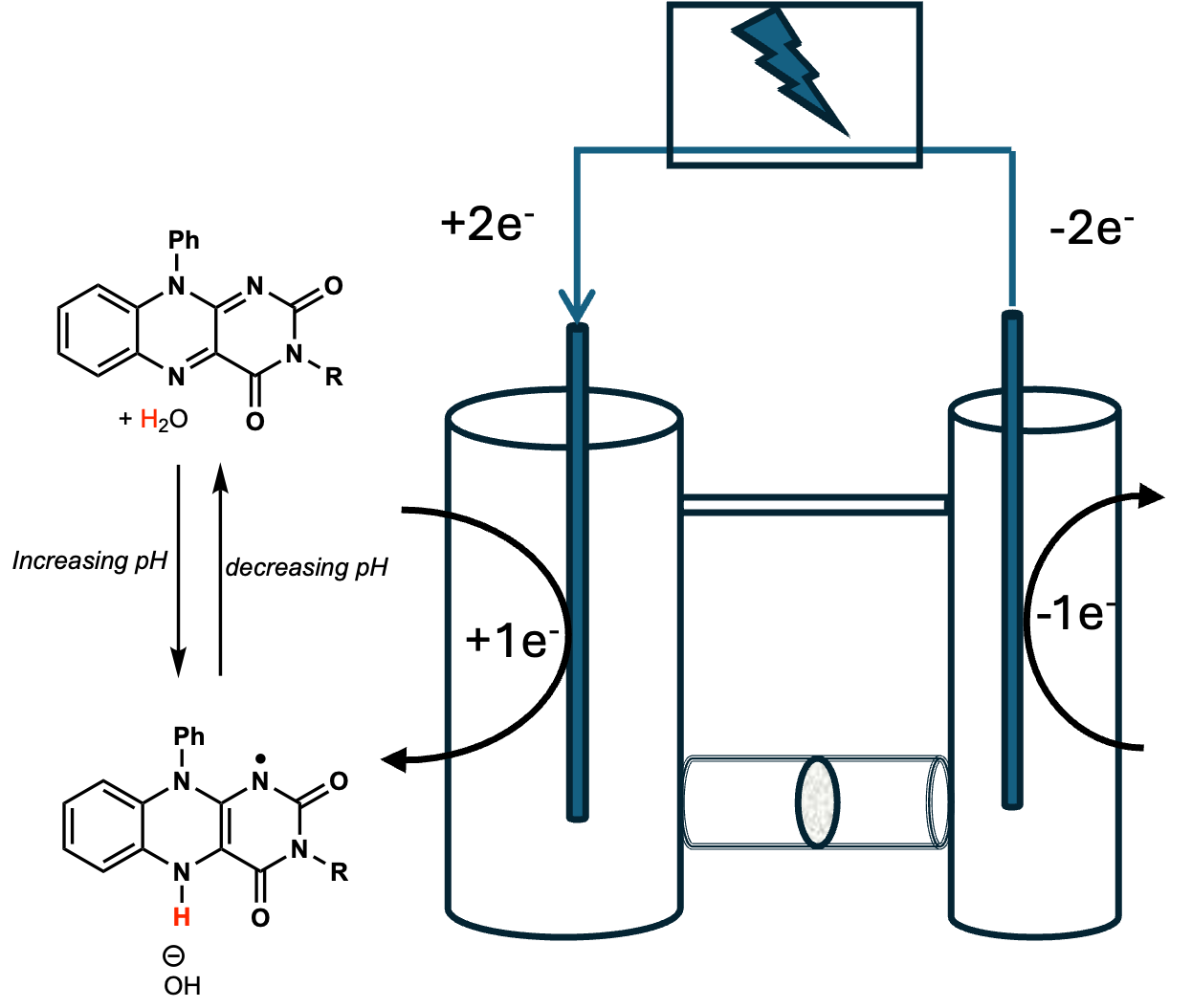
Flavins are biological cofactors whose proton-coupled electron transfer (PCET) chemistry drives essential redox processes across all living systems. My research asks: can we harness this biologically optimized 2e⁻/2H⁺ reactivity for CO₂ capture? The challenge is that natural flavins are poorly soluble in water, limiting their practical use. I addressed this by synthesizing novel alloxazine derivatives bearing distal charged groups that increase aqueous solubility while preserving the redox active core. Importantly, these distal groups lead to stability differences as demonstrated by spectroelectrochemical and pulse radiolysis studies.

Alloxazine derivatives
  • Demonstrated reversible 2e⁻/2H⁺ PCET redox chemistry.
  • Conducting pulse radiolysis experiments to observe transient radicals.
  • Integrating into flow cell architectures for continuous cycling.

Advanced Synthetic Methodology & Catalysis

Early in my graduate research experience, I had the opportunity to take part in rigorous, multi-step organic synthesis and complex catalysis. During my time in the Pronin Lab (UCI), I investigated cobalt-catalyzed radical–polar crossover reactions, running intricate, air-sensitive syntheses. By using isotopic labeling (¹⁸O) and multi-technique characterization (NMR, IR, mass spectrometry), I was able to elucidate some key steps of cobalt-salen catalyzed hydrofunctionalization and ring-opening reactions.

Cobalt-salen catalyzed reaction scheme
  • Executed multi-step air-sensitive synthetic campaigns.
  • Performed ¹⁸O isotopic labeling studies.

Computational Data Automation

I built custom Python-based tools to automate the processing of complex spectroscopic and electrochemical data, reducing analysis time and minimizing human error while mentoring undergraduate researchers in computational techniques.

  • Built custom Python automation pipelines.
  • Processed large CV, UV-Vis, and bulk electrolysis datasets.

Expertise

Technical expertise.

Electrochemical & Experimental

  • Cyclic Voltammetry & Bulk Electrolysis
  • Spectroelectrochemistry
  • Pulse Radiolysis & Transient Absorption
  • NMR, UV-Vis, IR/FTIR, GC/LC/ESI-MS

Computational & Data

  • TDDFT (Fugaku Supercomputer) & DFT
  • Python (NumPy, SciPy, pandas, Matplotlib)
  • TensorFlow / PyTorch for ML modeling
  • HPC Workflows & Data Pipeline Automation

Synthesis & Catalysis

  • Multi-step Organic Synthesis
  • Air-Sensitive Techniques (Schlenk/Glovebox)
  • Transition-Metal Catalysis
  • ¹⁸O Isotopic Labeling

Publications

Publications & awards.

  • In prep

    Design, Synthesis, and Studies of Hydroxymethylated Quinone Derivatives for Electrochemical CO₂ Capture

    Paul, P. K.; Lin, C. C.; Yang, J. Y.

    Manuscript in preparation

  • In prep

    Synthesis and Evaluation of Charged Flavin Derivatives for pH-Swing Mediated CO₂ Capture

    Paul, P. K.; Yang, J. Y.

    Manuscript in preparation

Fellowships & Awards

  • DOE SCGSR International Research Collaboration Award (IRCA) — RIKEN & Brookhaven National Lab 2026
  • DOE SCGSR Fellowship — Brookhaven National Laboratory 2026
  • Eugene Cota-Robles Fellowship — UC Irvine (1st & 4th Year)
  • Dissertation Year Fellowship — UC Irvine Summer 2025
  • UC LEADS Scholar — UC Riverside 2018

Teaching

Teaching & tutoring.

Individual and group tutoring for Chem 51A–C and upper-division organic chemistry, a free session every Thursday in person and on Zoom, and practice material posted by topic.

Contact

Contact.

Open to research collaborations and to teaching, postdoctoral, and industry R&D roles. Students: see organic chemistry tutoring, or text the number below.

Curriculum Vitae

Full CV with publications, presentations, fellowships, and research experience.

Download CV